
Live Edge Magic: Epoxy vs. Oil Finish—The Truth About Table Maintenance
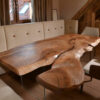
The live edge table has taken Canadian design by storm, turning a simple piece of furniture into a statement-making, organic work of art. Made from a single wood slab table, these pieces capture the raw beauty of the forest, transforming a rustic element—the tree’s natural edge—into modern luxury.
If you’re commissioning a Custom Live Edge Black Walnut Desk or a striking Live Edge Coffee Table, you’ve likely faced the most critical decision after choosing the slab: the finish. Specifically, the battle between a natural Oil Finish and a durable Epoxy Finish.
🌲 What Makes a Live Edge Table Unique?
A live edge table stands apart from its straight-edge counterparts because the woodworker preserves the original, natural contour of the tree along the sides of the slab.
- Natural Edge: Instead of sharp, milled lines, you get the unique, non-uniform curves, dips, and flow of the tree trunk. This can include sections of burl wood or unique texture.
- One-of-a-Kind: No two live edge pieces are identical. The table showcases the tree’s life story—its growth rings, knots, and natural cracks—making it a truly bespoke item.
- Sculptural Focal Point: It introduces an organic, softer element into a room full of straight architectural lines, instantly becoming the space’s centerpiece.
🛠️ Epoxy vs. Oil Finish: The Maintenance Debate
Is a live edge table more difficult to maintain than a finished table? Generally, a high-quality finished table is easier to maintain than bare wood. The type of finish, however, completely changes the maintenance routine.
| Feature | Natural Oil Finish (e.g., Hardwax Oil) | Epoxy Resin Fill / Coating |
| Look | Natural, matte/satin finish; the wood grain is tactile (you can feel the texture). | Glass-like, high-gloss (or matte/satin available); a smooth, non-porous surface. |
| Durability | Excellent protection against moisture/spills. Less resistant to deep scratches and heat rings. | Extremely durable, waterproof, scratch-resistant. Can yellow slightly over decades if not UV-stable. |
| Maintenance | Requires occasional re-oiling (typically every 6-12 months) to replenish protection. | Virtually maintenance-free. Clean with mild soap and water. No re-oiling needed. |
| Repair | Easy to spot-repair a scratch or mark by sanding the area and re-oiling it. | Difficult to repair deep scratches; often requires professional buffing or re-pouring. |
| Uses | Ideal for dining tables, desks, and pieces where a natural feel is prioritized. | Perfect for creating a “river table” or filling large natural cracks with a clear or tinted resin. |
The Truth: An Epoxy Finish is technically lower maintenance day-to-day (just wipe it down). A quality Oil Finish requires a bit more care (re-oiling), but is easier to repair if damage occurs.
💸 Investing in Canadian Slab Wood: Key Questions
1. How is the wood slab stabilized and dried (kiln-dried)?
For a piece to achieve heirloom quality, it must be properly dried. Wood is a hygroscopic material, meaning its wood moisture content changes with humidity, causing it to move, crack, or warp.
- Stabilization: Reputable Canadian suppliers use kiln-dried methods, where the wood is placed in a temperature and humidity-controlled oven. This process reduces the moisture content to a stable target (typically 6-8%) far faster and more consistently than air-drying, ensuring the slab is ready for building and will be stable in your home.
2. Can I choose the specific live edge slab used for my table?
Yes, you absolutely should! One of the greatest benefits of commissioning a piece from a custom maker like Home Madera is slab selection. You can often:
- View the current inventory of wood slabs (Walnut, Maple, Oak) in person or via high-resolution photos.
- Pick the exact slab whose grain, colour, and natural edge contour speaks to you.
- Work with the craftsman to decide which parts of the slab will be used for your table, whether it’s a standard table or a unique river table design.
3. What is the typical cost for a live edge slab from a Canadian supplier?
The cost of a raw wood slab depends heavily on the species, thickness, width, length, and rarity (burl wood).
- Cost Estimate: For a large, high-quality, kiln-dried slab suitable for a dining table (e.g., Black Walnut), the raw slab alone can range from $600 to $2,000+ CAD.
- Total Cost: Remember that this is only the cost of the raw material. The final price of a finished Custom Dining Table Canada includes the expert design, stabilization, bespoke joinery, labour, legs, and your chosen finish.
🛒 Ready to Find Your Perfect Slab?
Start the conversation and explore Canada’s finest live edge wood at Home Madera.
[Visit our shop at homemadera.ca and design your bespoke live edge masterpiece!]